Friday, July 28, 2006

Staying on Track

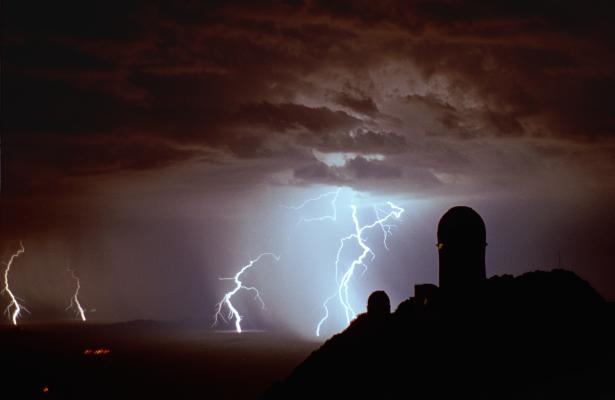
Yesterday, amid the crashing of thunder, the howling wind, and rain that frantically tapped on our windows, there was suddenly blaring silence. A familiar sound was abruptly cut off. That sound was the subtle hum of electricity and electrically Lightningpowered devices. The lights went out, the tape player became mute, and computer screens turned black. An emergency radio told us that it wasn’t the storm, but a problem at the power station, which left over 20,000 people without lights for 3 1/2 hours.

After a few minutes of sitting with flashlights for illumination, oil lamps were lit and began casting their warm glow across the living room. Although the appliances were eerily quiet, my family and I weren’t. We talked and talked and talked, and even though the conversation under those two burning wicks wasn’t much different than normal everyday conversing, it seemed better than any under white hot tungsten.

Why? Well I think it is because that was our only focus. You see, I feel that all too often we don’t wholly focus on what we’re doing. For example, I consider myself fairly “unplugged”. When I get busy, blogging is one of the first things that I cut back on. But, I do find that I check e-mail from time to time while doing schoolwork, or even chores. I “multitask”. During normal conversation I can let my mind wander, mentally “multitasking”, instead of listening as I should.

LightningFor a person, I think most multi-tasking causes lower productivity; we just weren’t designed to think about multiple things at once. As Adrian Rogers has said, to this effect, “God made us with a one track mind, if you’re thinking about the right thing, you can’t be thinking about the wrong thing.” I want to think about the right things, I want to properly focus on what I am doing. When I’m doing schoolwork that is what I’ll do, when I’m doing chores, that is what I’ll do. I am purposing not to be distracted from what is really important, such as obeying God. Without Him as my desire, I am like the dust of the ground, trampled and beaten down, with Him, I can soar like an eagle.

Finally, brethren, whatsoever things are true, whatsoever things are honest, whatsoever things are just, whatsoever things are pure, whatsoever things are lovely, whatsoever things are of good report; if there be any virtue, and if there be any praise, think on these things.
PHILIPIANS 4:8

Written by: Zachary J. of Wholesome Works

P.S. For some really good posts on the dangers of multitasking, read some of these posts on The Rebelution; Multitasking Intro, Part one, and Part two.

Tuesday, July 25, 2006

Is the Bible Reliable?


The Bible is God’s word. It is what He has told us about life. Therefore, just as it is important that we know that the Bible is scientifically accurate, it is very important that we know the Bible is completely reliable, and why.

The Traveler, after returning from World View Academy, has written some very good post on the reliability of the Bible.

Here is a small part of the first post:

“During my week at Worldview Academy (WVA), my favorite lecture was “Reliability of Scripture,” given by Jay Winslow. Although I’ve been brought up my entire life to trust the Bible, sometimes I’ve wondered why I should believe the Bible.

How do I know that it’s true?

Several months ago, during the first day of my sociology class, our professor told us to come with an open mind, leaving our religion and biases at the door. I believe she did this because it some sense, she did not believe that faith and reason are compatible. WVA lecturer Jay Winslow, pointed out a common assumption of unbelievers, ‘If you believe in the Bible, you’re a little bit wacky.’”

Read the rest - Here

Also read the Second and Third parts.

I think there will be more to come, so make sure you continue to check her blog!

Monday, July 24, 2006

So What About UFOs?


How, then, should one understand the UFO phenomena and all the associated hype? In the German magazine Focus, it was stated, “90% of UFO reports turn out to be humbug, but there is a residual 10% which are not easy to dismiss.”

The article quoted sociologist Gerald Eberlein as saying:

"Research has shown that people who are not affiliated with any church, but who claim that they are religious, are particularly susceptible to the possible existence of extraterrestrials. For them, ufology is a substitute religion."

The Bible, in 2 Thessalonians 2:9 - 11, goes somewhat deeper in this matter, identifying a supplementary cause and effect:

"Whose coming is according to the working of Satan with all power and signs and lying wonder, and with all deceit of unrighteousness in those who perish, because they did not receive the love of the truth, so that they might be saved. And for this cause God shall send them strong delusion, that they should believe a lie."

The Bible gives a description of reality concerning all living things. The living God reveals Himself as the Triune One, the Father, Son, and Holy Spirit. In Heaven, there are the angels, powerful created beings who also serve mankind on Earth.

There is another kingdom, it is of the devil and the demons. Ephesians 2:2 talks about the "prince of the power of the air," whose reign is on Earth.

The devil has his own repertoire of deception in the form of various occult practices and a multitude of religious rites. It could be that behind those unexplainable UFO reports is the work of the archdeceiver.

UFO reports, by definition, remain nebulous and not identifiable. People who do not know Christ are easily fascinated by all sorts of phenomena that are difficult to explain. For Christians, there is Jesus’ warning, in Matthew 24:4, to "take heed that no man deceive you." What is the best antidote to deception? Paul exhorts us in 2 Timothy 2:15, to "study" the Scripture, so we might "accurately handle the word of truth."


Sign of Design: It cannot be stressed enough that what natural selection actually does is get rid of information. It is not capable of creating any thing new, by definition.

Friday, July 21, 2006

Vast Distances (part 2 of 2)

Continuation of 4. Vast Distances (part 1 of 2)

At the incredible speed of one- tenth of the speed of light, the trip to Proxima Centuri (Alpha Centuri C), one way, would still take 47 years. One would need, however, enormous amounts of energy for such acceleration, roughly equivalent to the total energy that the world’s largest hydroelectric power station, with all 18 of its turbines running, generates in 4 days.

Furthermore, in every cubic kilometer (approx. 1/4 of a cubic mile) of space, there are an estimated 100,000 dust particles (made up of silicate and ice) weighing only a tenth of a gram. But at such a velocity, colliding with even one of these tiny objects could destroy a spaceship.

Sign of Design: Even though the Bible's purpose is not to teach history as such, the history it teaches is true.

Wednesday, July 19, 2006

4. Vast Distances (part 1 of 2)

Even if we assumed life existed somewhere else in the universe, a visit by extraterrestrials, to Earth, such as is claimed in UFO reports, seems completely impracticable, if not impossible. The distances (and therefore the likely travel times) are unimaginably vast.

The closest star to Earth, Proxima Centuri (Alpha Centuri C), is 40.7 trillion kilometers (approximately 25 trillion (25,000,000,000,000,000) miles) away. The Apollo flights took three days to get to the moon. At the same speed, one would need 870,000 years to get to this nearest star. Of course, one could accelerate (particularly unmanned) probes to a greater speed.

To be continued...

Sign of Design: One reason put forward for saying that Genesis is "non-scientific" is that the account is brief. But since when does brevity equal inaccuracy?